The A to Z of Ethics by Harry J. Gensler & Earl W. Spurgin
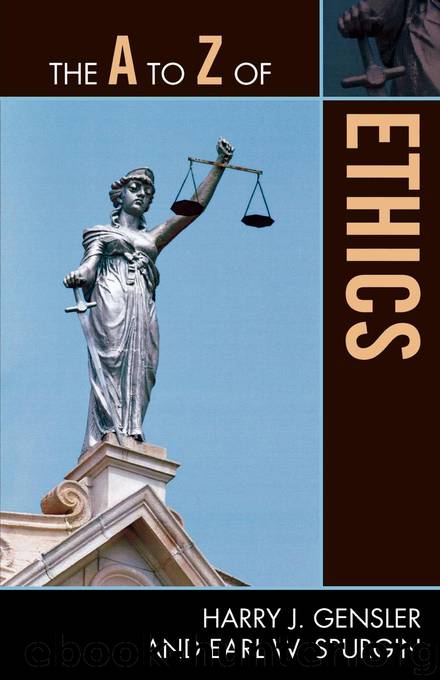
Author:Harry J. Gensler & Earl W. Spurgin
Language: eng
Format: epub
Publisher: Scarecrow Press
Published: 2008-03-14T16:00:00+00:00
– L –
LAW. See ABORTION AND INFANTICIDE; ANIMALS; AQUINAS, THOMAS; AUTONOMY/HETERONOMY; BENTHAM, JEREMY; BIBLICAL ETHICS; BIOETHICS; BUSINESS ETHICS; CAPITAL PUNISHMENT; CIVIL DISOBEDIENCE; COMPUTER ETHICS; DOUBLE EFFECT; DWORKIN, RONALD; ISLAMIC ETHICS; JUSTICE; KANT, IMMANUEL; KING, MARTIN LUTHER; LOCKE, JOHN; MARX, KARL; MILL, JOHN STUART; NATURAL LAW; PATERNALISM; POLITICAL PHILOSOPHY; PORNOGRAPHY; PRIVACY; PUFENDORF, SAMUEL; PUNISHMENT; RAWLS, JOHN; ROSS, W. D.; ROUSSEAU, JEAN-JACQUES; STEM-CELL RESEARCH.
LEWIS, C. I. (1883–1964). Clarence Irving Lewis was an American philosopher at Harvard who contributed to logic, epistemology, and ethics. He wrote the first history of logic in English and was the father of modern modal logic. He was a bridge between pragmatism and the new American analytic tradition that he helped construct; his students included Willard Van Orman Quine, Nelson Goodman, Roderick Chisholm, and William Frankena. He spent his last decades on ethics. He defends moral truths, which he thinks are presupposed by intelligent action. His An Analysis of Knowledge and Valuation (1947) argues that both scientific inquiry and morality are goal oriented and that human goals provide a naturalistic, empirical basis for judgments about what is good; this accords with the pragmatist tradition of William James, John Dewey, and Ralph Perry. His The Ground and Nature of the Right (1955) is more Kantian; its principles of right action are pragmatic a priori imperatives that a rational being cannot reject. Those who argue for skepticism are caught in a pragmatic contradiction since their arguments assume epistemic, logical, and ethical norms. The basic rational imperative is “Be consistent in thought and action.” This involves the idea that no way of thinking or acting is valid for anyone unless it would be valid for everyone else in the same circumstances. Lewis formulates his supreme categorical imperative in several ways, including: “Act toward others as if the effects of your actions were to be realized with the poignancy of the immediate—hence, in your own person” and “Act as if you were to live out in sequence your life and the lives of those affected by your actions.”
LIBERALISM/COMMUNITARIANISM. The competing positions in an important debate in political philosophy. Very roughly, liberalism emphasizes the rights of the individual while communitarianism emphasizes the interests and values of the community.
Although the current debate arose after John Rawls’s A Theory of Justice (1971), its roots are much deeper. Rawls developed ideas from classical liberal philosophers such as John Locke, Immanuel Kant, and John Stuart Mill. Using instead thinkers such as Aristotle, Jean-Jacques Rousseau, and Georg Wilhelm Friedrich Hegel, contemporary philosophers such as Alasdair MacIntyre, Michael Sandel, Charles Taylor, and Michael Walzer criticized Rawls in ways labeled “communitarian” (though some of these thinkers do not like the term).
Liberalism holds that individuals have rights and liberties and that the state exists to promote these. People should be free to live as they wish as long as they respect the equal rights of others; so I cannot shoot a gun at you since that violates your rights. Locke’s social contract theory was perhaps the first systematic formulation of liberalism.
Download
This site does not store any files on its server. We only index and link to content provided by other sites. Please contact the content providers to delete copyright contents if any and email us, we'll remove relevant links or contents immediately.
| Anthropology | Archaeology |
| Philosophy | Politics & Government |
| Social Sciences | Sociology |
| Women's Studies |
The remains of the day by Kazuo Ishiguro(9093)
Tools of Titans by Timothy Ferriss(8500)
Giovanni's Room by James Baldwin(7441)
The Black Swan by Nassim Nicholas Taleb(7200)
Inner Engineering: A Yogi's Guide to Joy by Sadhguru(6839)
The Way of Zen by Alan W. Watts(6674)
The Power of Now: A Guide to Spiritual Enlightenment by Eckhart Tolle(5856)
Asking the Right Questions: A Guide to Critical Thinking by M. Neil Browne & Stuart M. Keeley(5838)
The Six Wives Of Henry VIII (WOMEN IN HISTORY) by Fraser Antonia(5560)
Astrophysics for People in a Hurry by Neil DeGrasse Tyson(5227)
Housekeeping by Marilynne Robinson(4507)
Double Down (Diary of a Wimpy Kid Book 11) by Jeff Kinney(4339)
12 Rules for Life by Jordan B. Peterson(4333)
Ikigai by Héctor García & Francesc Miralles(4313)
The Ethical Slut by Janet W. Hardy(4311)
Skin in the Game by Nassim Nicholas Taleb(4310)
The Art of Happiness by The Dalai Lama(4170)
Skin in the Game: Hidden Asymmetries in Daily Life by Nassim Nicholas Taleb(4052)
Walking by Henry David Thoreau(4004)
